![[personal profile]](https://www.dreamwidth.org/img/silk/identity/user.png)
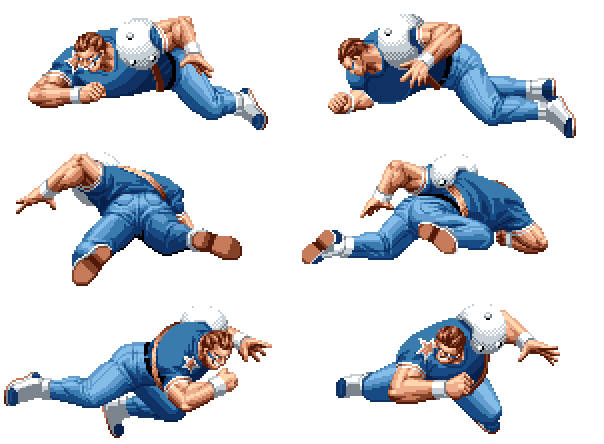
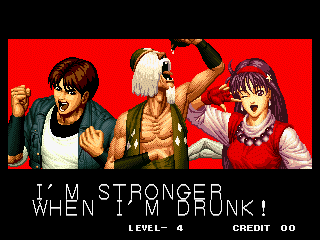
Virtua Fighter.
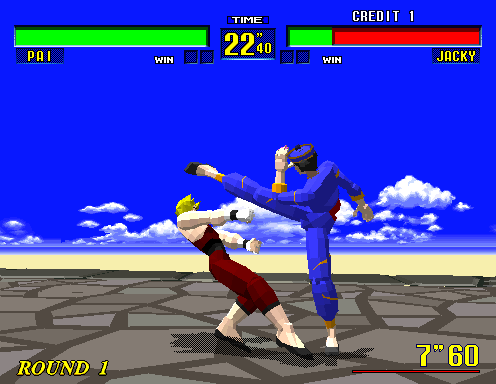
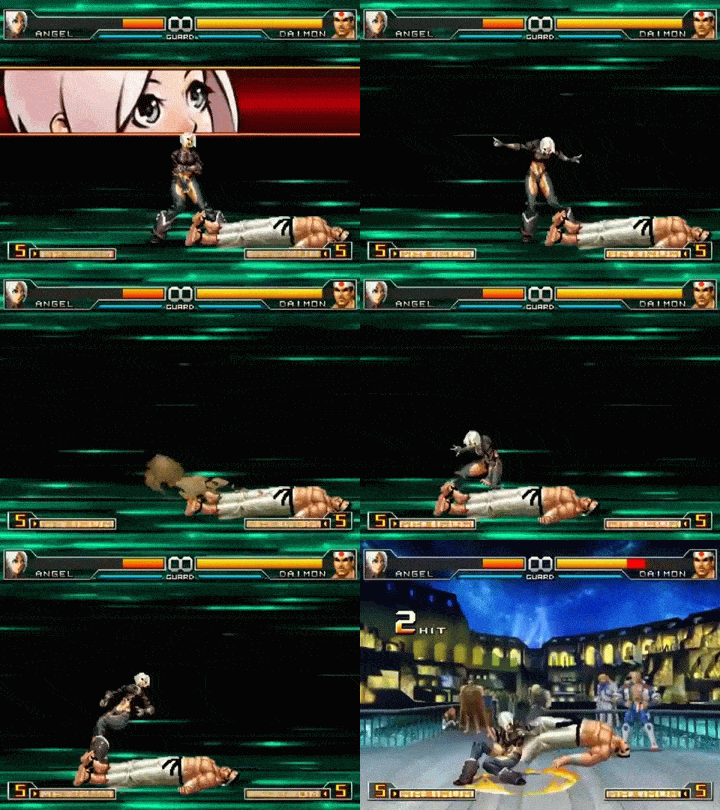
Tekken.
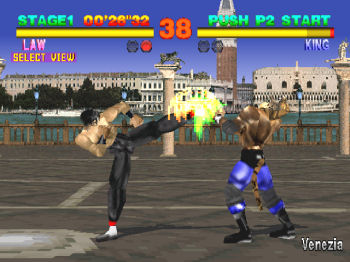
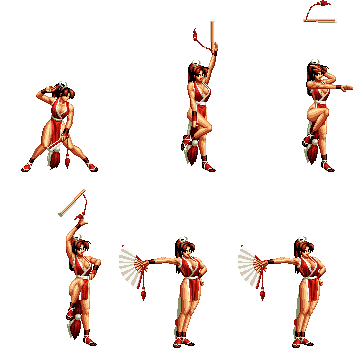
Dead or Alive.

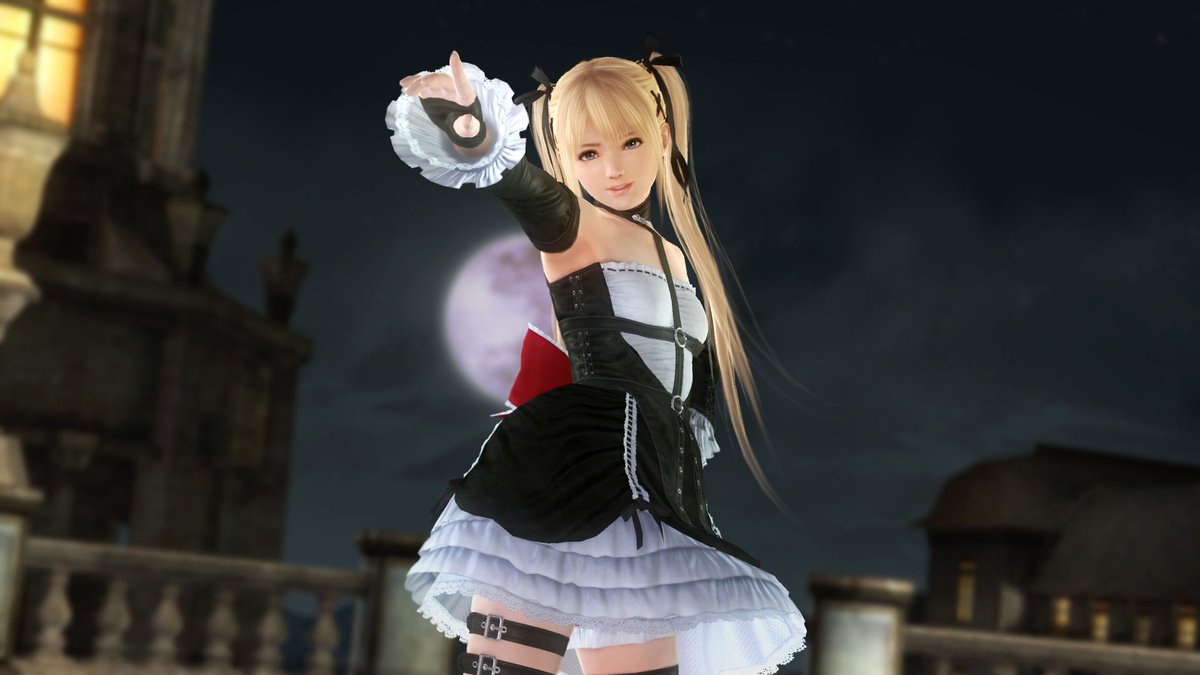
These three games were instrumental in establishing the 3D fighter sub-genre, and are among the most well-known franchises of their creators - Sega, Namco, and Tecmo, respectively. But they weren't their developers' first attempt at fighting games - all three companies had prior experience in 2D fighters, and (for the most part) they had a bit more to them than the plethora of "we have Street Fighter II at home" efforts that clogged up arcade floors in the early to mid 90s.
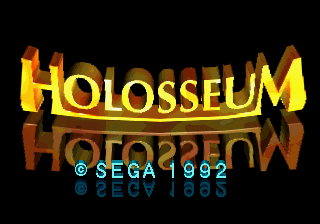
Holosseum (Sega, 1992)
In 1991, Sega released Time Traveler, designed by Dragon's Lair creator Rick Dyer - like Dragon's Lair, it was a Laserdisc game, but unlike Dragon's Lair, it came in a special cabinet which used a concave mirror to create an optical illusion in which the game's graphics appear as holograms floating on a stage which Sega called the "Micro-Theater". It seemed to perform well, with Japanese arcade trade magazine Game Machine naming it the eigth most sucessful upright cabinet in a late 1991 issue, and it received a nomination for the Most Innovative New Technology award at the 1992 AMOA Awards. But Street Fighter II was the big dog in the arcades by this point, and Sega figured that if they could combine the presentation of Time Traveler wth the action of SF2, they'd have a mega-hit on their hands.
Spoiler alert: they didn't.
Holosseum was released in November 1992 as a conversion kit for Time Traveler. Sure enough, it delivered on its promise of pseudo-holographic fighters duking it out in the Micro-Theater, but that's more or less where the positives end for this game. Of course, you're not going to get the full experience playing it in MAME, but you would think that it couldn't have been too hard for Sega to make this work on a gameplay level, as oppposed to purely as a spectacle. Instead, arcade-goers were "treated" to four playable characters and a play area that consisted of, if I'm being generous, the middle 50% of the screen between the life bars.
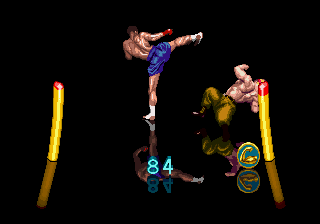
On the other hand, it does have an announcer who says it's always great to see guys in good shape, and who am I to argue?
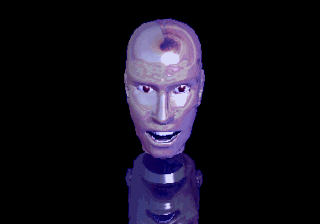
The final word goes to GameFAQs contributor Anonymommy, who actually went to the trouble of compiling a move list for this game (and is also responsible for the iconic quote: "Chances are there won't be a Strip Fighter tournament coming to your town anytime soon, but that doesn't mean you shouldn't be training for one."):
"Not surprisingly, Holosseum is more fun to watch than it is to play. In fact, playing it is no fun at all. This FAQ is dedicated to anyone who gave it a chance."
Burning Rival (Sega, 1993)
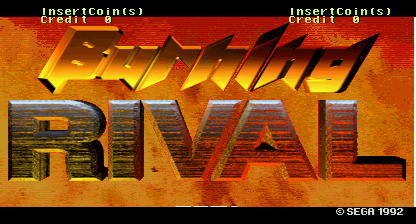
The second of three Sega games I'm looking at (in order of how interesting I find them, rather than chronologically - while all three games have a 1992 copyright date, the Domestic and Overseas Arcade Game List 1971-2005 indicates a more likely release date of August '93 for this game) is Burning Rival. The game certainly has an interesting art style, thanks to animation studio Zero-One who were responsible for most of the graphics. The backgrounds aren't great, but the character sprites are easily the highlight of this game - they wouldn't look out of place in a game five or more years more recent than this.
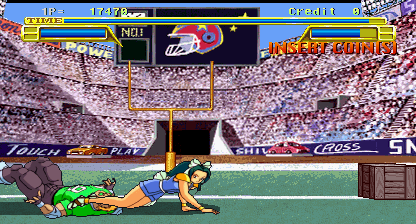
The gameplay doesn't stray too far from the SF2 formula; the controls are three punch buttons and three kick buttons, but a few characters have juggle combos (which Street Fighter wouldn't have (intentionally, at least) until 1994's Super SF2 Turbo). Not only that, but when you defeat your opponent with a light punch or light kick:
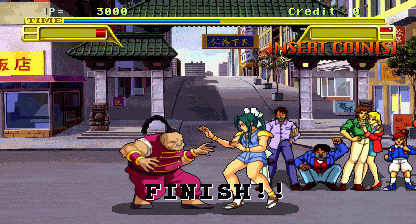
Were fatalities planned for this game? Are they in the game anyway, and no-one ever figured out how to do them? Who knows? (OK, it's most likely that they thought it didn't look good if you just knocked someone out with a jab, and did this in order to give you the chance to finish them off with something a bit more substantial.)
There doesn't seem to be too much information out there on how this game was received upon release, and apart from the excellent graphics, this game is just... kind of there.
Dark Edge (Sega, 1993)
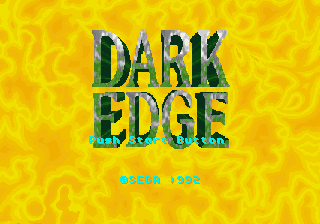
This predates Burning Rival by a few months, but feels much more like an immediate precursor to Virtua Fighter. That's because this is, in effect, a 3D fighter - albeit one based on sprite scaling rather than polygons.
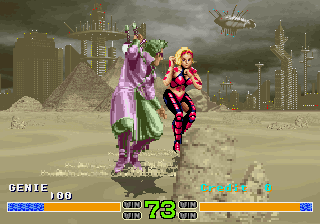
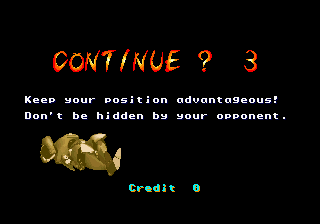
In fact, it's more 3D than most 3D fighters, as you can move freely into the foreground and background. However, some basic functions are sacrificed in order to make this happen; there is no crouching (except for a "squat attack" performed by pressing one of the game's four attack buttons with the joystick in neutral) and there is a dedicated jump button. There is also no effort to keep the camera side-on; it faces in the same direction at all times, which leads to some awkward moments when one fighter is blocking your view of the other. The game does acknowledge this in one of the continue screen hints, to be fair.
In a report on the ATEI '93 trade show in the April 1993 issue of Sega Zone, Rik Haynes was enthusiastic about this game, rating it at 4/5 - although in the same report he rates Holosseum (spelled "Holsseum") at 5/5 and seminal puzzle game Puyo Puyo at 1/5. Sega Zone does not seem to have been a particularly high-quality publication, is what I'm saying. In any case, Dark Edge is a game with some interesting ideas, but not the best execution.
Knuckle Heads (Namco, 1993)
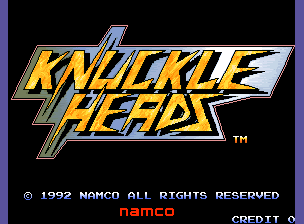
For their initial entry into the genre, Namco decided that adding another two players to the mix was what they needed to differentiate themselves from SF2. Start up a single player game and it doesn't look too different to SF2:
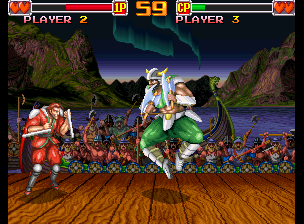
Insert a few more coins, though, and this is what awaits:

It's a three-button game, with high attack, low attack, and jump buttons - because while the one-on-one mode functions like most other 2D fighters, with all the action taking place on a single plane, in the four-player mode you have a bit of Z-axis to play with, much like a scrolling beat-em-up. Another feature of this game is the "aura moves"; by holding down an attack button for a second you make that attack more powerful (holding it for two or more seconds makes it even more powerful), and there are aura special moves in which you hold down a button, perform the joystick motion for a special move, then release the button - sort of like the EX special moves in more modern fighting games, except instead of using a meter they're done with a more elaborate command (Fighter's History Dynamite has something along the same lines).
Namco brought in some serious voice acting talent fror this game; Rob and Gregory are voiced by Nobuo Tobita (best known at the time for playing Kamille Bidan), Takeshi by Toshiyuki Morikawa (Tekkaman Blade), Christine by Megumi Hayashibara (female Ranma), and Claudia by Kotono Mitsuishi (Sailor Moon).
As with Burning Rival, information on how the game was received is not easy to come by; the game's Wikipedia page states that Japanese publication Game Machine rated it the seventh most-successful "table arcade game", whatever that means, in an April 1993 issue, while US publication RePlay reported in their November 1993 issue that it was the 19th most popular arcade game at the time. Personally, I liked some of the ideas, but not so much how they were executed, so it's a bit similar to Dark Edge in that regard.
Touki Denshou: Angel Eyes (Tecmo, 1996)
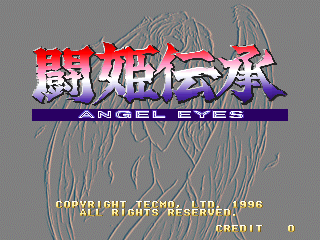
Picture the scene: you're walking through a Japanese arcade sometime in the summer of 1996. In the corner of your eye, you catch a glimpse of the attract mode of a new game.
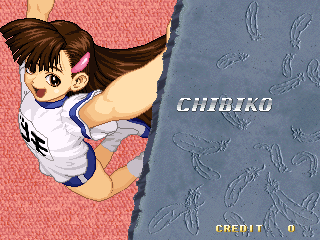
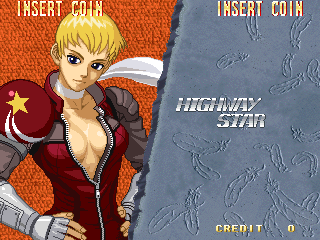
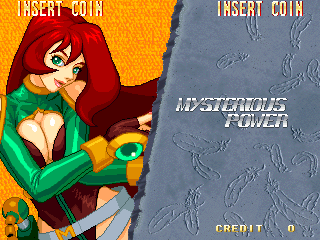
OK, we've got some decent pixel art, some of the character names are extremely silly but we can live with that, I'll go ahead and insert my 100 yen...
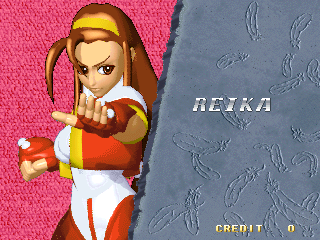
...sorry, what???
If you're wondering how this weird mishmash of pixel art and CGI came about, then you're in luck as the game's planner, Jun Hasunuma, kept a development diary, which was translated into English by Sudden Desu. A brief summary: the project started out as a way to utilise assets from a cancelled Ninja Gaiden sequel. Eventually, this becomes an all-girl fighting game similar to Asuka 120% or Variable Geo. One of the game's artists experiments with CGI while designing a new character; management sees this and says "excellent, can we have the remaining characters done like this, please?".
(There's a half-hearted attempt at a storyline explanation for this; the fighters have all been posessed by angels vying to become the archangel, and in the case of Kiriko and Reika, they are described as being more synchronised with the angels, resulting in their more metallic appearance. Also, their full names are Kiriko Kasumi and Lei Fang respectively; despite this, the developers, in the Touki Gentei fan book, disclaim any connection to the Dead or Alive characters of the same names. As for Lina, she's a cyborg.)
The game goes through further difficulties, nearly getting cancelled, before finally releasing in June of 1996, a few months before its more famous stablemate Dead or Alive hit arcades.
With that being said, how does the game play? Much like the aforementioned Asuka 120%, this is an early example of what these days we would call an anime fighter. There are four attack buttons - LP, LK, HP, HK, KOF-style - which can be chained together in that order. There is a massive range of movement options by the standards of the time, including some which are still, as far as I can tell, unique to this game (quadruple jumps, mid-air spot dodges). Each round starts with the characters leaping towards each other, suggesting that the developers really wanted to show off this game's aerial movement, and there are no corners - the stages scroll infinitely.
Its most well-known gameplay quirk, though, is how combo damage is worked out. By this point, the convention had been established that as the length of a combo increases, the damage each hit does, as a percentage of its base damage, decreases; otherwise known as damage scaling.
Touki Denshou: Angel Eyes... does not do this.
Here's what it does instead:
Yes, that is a touch of death combo starting from a throw.
That said, there seems to be a bit of a competitive scene for this game, despite (or maybe because of) its idiosyncracies. It helps that, unlike the other games here, it can be played online via Fightcade. Not only that, but there's a wiki for this game on Mizuumi, the number one source for info on obscure fighting games, and there's an excellent FAQ by afroshouji which was updated as recently as last year (despite the initial version dating back as far as 1998).
This is also the only one of these games to have received a somewhat contemporary console port; this was released in Japan for the PS1 in December 1997, about 18 months after the arcade version. It adds pixel art versions of Kiriko, Lina, and Reika as unlockable characters, although the wild gameplay is left more or less untouched.
Out of all the games covered here, this was the one I found the most interesting by far. Had the development team been given more time to properly finish this game, I reckon this could have been decently popular. As it is, it's more of a weird-looking curiosity, but if I had to recommend one of these games, this would definitely be it.
Conclusion
Of the five games covered here, the only one I would call a clear-cut dud is Holosseum. The other four all have something to help them stand out in the 2D fighter marketplace, and in particular I think Touki Denshou: Angel Eyes could have become a bit of a cult classic with a little more polish.
Sega and Namco were not entirely done with 2D fighters after this, either; Eternal Champions arrived on the Mega Drive shortly after Virtua Fighter hit arcades, and Namco had a couple of efforts in 1995; in the arcade, The Outfoxies introduced the idea of the platform fighter, while on the 16-bit consoles, a US-based team including former Capcom employees James Goddard and Dave Winstead put out Weaponlord, an early attempt at online versus play with the XBAND system.
Until next time...
Tekken.
Dead or Alive.
These three games were instrumental in establishing the 3D fighter sub-genre, and are among the most well-known franchises of their creators - Sega, Namco, and Tecmo, respectively. But they weren't their developers' first attempt at fighting games - all three companies had prior experience in 2D fighters, and (for the most part) they had a bit more to them than the plethora of "we have Street Fighter II at home" efforts that clogged up arcade floors in the early to mid 90s.
Holosseum (Sega, 1992)
In 1991, Sega released Time Traveler, designed by Dragon's Lair creator Rick Dyer - like Dragon's Lair, it was a Laserdisc game, but unlike Dragon's Lair, it came in a special cabinet which used a concave mirror to create an optical illusion in which the game's graphics appear as holograms floating on a stage which Sega called the "Micro-Theater". It seemed to perform well, with Japanese arcade trade magazine Game Machine naming it the eigth most sucessful upright cabinet in a late 1991 issue, and it received a nomination for the Most Innovative New Technology award at the 1992 AMOA Awards. But Street Fighter II was the big dog in the arcades by this point, and Sega figured that if they could combine the presentation of Time Traveler wth the action of SF2, they'd have a mega-hit on their hands.
Spoiler alert: they didn't.
Holosseum was released in November 1992 as a conversion kit for Time Traveler. Sure enough, it delivered on its promise of pseudo-holographic fighters duking it out in the Micro-Theater, but that's more or less where the positives end for this game. Of course, you're not going to get the full experience playing it in MAME, but you would think that it couldn't have been too hard for Sega to make this work on a gameplay level, as oppposed to purely as a spectacle. Instead, arcade-goers were "treated" to four playable characters and a play area that consisted of, if I'm being generous, the middle 50% of the screen between the life bars.
On the other hand, it does have an announcer who says it's always great to see guys in good shape, and who am I to argue?
The final word goes to GameFAQs contributor Anonymommy, who actually went to the trouble of compiling a move list for this game (and is also responsible for the iconic quote: "Chances are there won't be a Strip Fighter tournament coming to your town anytime soon, but that doesn't mean you shouldn't be training for one."):
"Not surprisingly, Holosseum is more fun to watch than it is to play. In fact, playing it is no fun at all. This FAQ is dedicated to anyone who gave it a chance."
Burning Rival (Sega, 1993)
The second of three Sega games I'm looking at (in order of how interesting I find them, rather than chronologically - while all three games have a 1992 copyright date, the Domestic and Overseas Arcade Game List 1971-2005 indicates a more likely release date of August '93 for this game) is Burning Rival. The game certainly has an interesting art style, thanks to animation studio Zero-One who were responsible for most of the graphics. The backgrounds aren't great, but the character sprites are easily the highlight of this game - they wouldn't look out of place in a game five or more years more recent than this.
The gameplay doesn't stray too far from the SF2 formula; the controls are three punch buttons and three kick buttons, but a few characters have juggle combos (which Street Fighter wouldn't have (intentionally, at least) until 1994's Super SF2 Turbo). Not only that, but when you defeat your opponent with a light punch or light kick:
Were fatalities planned for this game? Are they in the game anyway, and no-one ever figured out how to do them? Who knows? (OK, it's most likely that they thought it didn't look good if you just knocked someone out with a jab, and did this in order to give you the chance to finish them off with something a bit more substantial.)
There doesn't seem to be too much information out there on how this game was received upon release, and apart from the excellent graphics, this game is just... kind of there.
Dark Edge (Sega, 1993)
This predates Burning Rival by a few months, but feels much more like an immediate precursor to Virtua Fighter. That's because this is, in effect, a 3D fighter - albeit one based on sprite scaling rather than polygons.
In fact, it's more 3D than most 3D fighters, as you can move freely into the foreground and background. However, some basic functions are sacrificed in order to make this happen; there is no crouching (except for a "squat attack" performed by pressing one of the game's four attack buttons with the joystick in neutral) and there is a dedicated jump button. There is also no effort to keep the camera side-on; it faces in the same direction at all times, which leads to some awkward moments when one fighter is blocking your view of the other. The game does acknowledge this in one of the continue screen hints, to be fair.
In a report on the ATEI '93 trade show in the April 1993 issue of Sega Zone, Rik Haynes was enthusiastic about this game, rating it at 4/5 - although in the same report he rates Holosseum (spelled "Holsseum") at 5/5 and seminal puzzle game Puyo Puyo at 1/5. Sega Zone does not seem to have been a particularly high-quality publication, is what I'm saying. In any case, Dark Edge is a game with some interesting ideas, but not the best execution.
Knuckle Heads (Namco, 1993)
For their initial entry into the genre, Namco decided that adding another two players to the mix was what they needed to differentiate themselves from SF2. Start up a single player game and it doesn't look too different to SF2:
Insert a few more coins, though, and this is what awaits:
It's a three-button game, with high attack, low attack, and jump buttons - because while the one-on-one mode functions like most other 2D fighters, with all the action taking place on a single plane, in the four-player mode you have a bit of Z-axis to play with, much like a scrolling beat-em-up. Another feature of this game is the "aura moves"; by holding down an attack button for a second you make that attack more powerful (holding it for two or more seconds makes it even more powerful), and there are aura special moves in which you hold down a button, perform the joystick motion for a special move, then release the button - sort of like the EX special moves in more modern fighting games, except instead of using a meter they're done with a more elaborate command (Fighter's History Dynamite has something along the same lines).
Namco brought in some serious voice acting talent fror this game; Rob and Gregory are voiced by Nobuo Tobita (best known at the time for playing Kamille Bidan), Takeshi by Toshiyuki Morikawa (Tekkaman Blade), Christine by Megumi Hayashibara (female Ranma), and Claudia by Kotono Mitsuishi (Sailor Moon).
As with Burning Rival, information on how the game was received is not easy to come by; the game's Wikipedia page states that Japanese publication Game Machine rated it the seventh most-successful "table arcade game", whatever that means, in an April 1993 issue, while US publication RePlay reported in their November 1993 issue that it was the 19th most popular arcade game at the time. Personally, I liked some of the ideas, but not so much how they were executed, so it's a bit similar to Dark Edge in that regard.
Touki Denshou: Angel Eyes (Tecmo, 1996)
Picture the scene: you're walking through a Japanese arcade sometime in the summer of 1996. In the corner of your eye, you catch a glimpse of the attract mode of a new game.
OK, we've got some decent pixel art, some of the character names are extremely silly but we can live with that, I'll go ahead and insert my 100 yen...
...sorry, what???
If you're wondering how this weird mishmash of pixel art and CGI came about, then you're in luck as the game's planner, Jun Hasunuma, kept a development diary, which was translated into English by Sudden Desu. A brief summary: the project started out as a way to utilise assets from a cancelled Ninja Gaiden sequel. Eventually, this becomes an all-girl fighting game similar to Asuka 120% or Variable Geo. One of the game's artists experiments with CGI while designing a new character; management sees this and says "excellent, can we have the remaining characters done like this, please?".
(There's a half-hearted attempt at a storyline explanation for this; the fighters have all been posessed by angels vying to become the archangel, and in the case of Kiriko and Reika, they are described as being more synchronised with the angels, resulting in their more metallic appearance. Also, their full names are Kiriko Kasumi and Lei Fang respectively; despite this, the developers, in the Touki Gentei fan book, disclaim any connection to the Dead or Alive characters of the same names. As for Lina, she's a cyborg.)
The game goes through further difficulties, nearly getting cancelled, before finally releasing in June of 1996, a few months before its more famous stablemate Dead or Alive hit arcades.
With that being said, how does the game play? Much like the aforementioned Asuka 120%, this is an early example of what these days we would call an anime fighter. There are four attack buttons - LP, LK, HP, HK, KOF-style - which can be chained together in that order. There is a massive range of movement options by the standards of the time, including some which are still, as far as I can tell, unique to this game (quadruple jumps, mid-air spot dodges). Each round starts with the characters leaping towards each other, suggesting that the developers really wanted to show off this game's aerial movement, and there are no corners - the stages scroll infinitely.
Its most well-known gameplay quirk, though, is how combo damage is worked out. By this point, the convention had been established that as the length of a combo increases, the damage each hit does, as a percentage of its base damage, decreases; otherwise known as damage scaling.
Touki Denshou: Angel Eyes... does not do this.
Here's what it does instead:
Yes, that is a touch of death combo starting from a throw.
That said, there seems to be a bit of a competitive scene for this game, despite (or maybe because of) its idiosyncracies. It helps that, unlike the other games here, it can be played online via Fightcade. Not only that, but there's a wiki for this game on Mizuumi, the number one source for info on obscure fighting games, and there's an excellent FAQ by afroshouji which was updated as recently as last year (despite the initial version dating back as far as 1998).
This is also the only one of these games to have received a somewhat contemporary console port; this was released in Japan for the PS1 in December 1997, about 18 months after the arcade version. It adds pixel art versions of Kiriko, Lina, and Reika as unlockable characters, although the wild gameplay is left more or less untouched.
Out of all the games covered here, this was the one I found the most interesting by far. Had the development team been given more time to properly finish this game, I reckon this could have been decently popular. As it is, it's more of a weird-looking curiosity, but if I had to recommend one of these games, this would definitely be it.
Conclusion
Of the five games covered here, the only one I would call a clear-cut dud is Holosseum. The other four all have something to help them stand out in the 2D fighter marketplace, and in particular I think Touki Denshou: Angel Eyes could have become a bit of a cult classic with a little more polish.
Sega and Namco were not entirely done with 2D fighters after this, either; Eternal Champions arrived on the Mega Drive shortly after Virtua Fighter hit arcades, and Namco had a couple of efforts in 1995; in the arcade, The Outfoxies introduced the idea of the platform fighter, while on the 16-bit consoles, a US-based team including former Capcom employees James Goddard and Dave Winstead put out Weaponlord, an early attempt at online versus play with the XBAND system.
Until next time...